ANGKOR World heritage. This blog are talking about Cambodia history and the wonderful heritage in Cambodia. From day to day a lot of tourist are coming to visit especially Angkor Wat that is the 7 wonder heritage in the world
Preah Vihear Temple is an ancient Hindu temple built during the period of the Khmer Empire, that is situated atop a 525-metre cliff in the Dângrêk Mountains, in the Preah Vihear province, Cambodia.
Classical Dance of Cambodia The epic poem of Rama (Ramayana) is believed to have been revealed to a Hindu holy man named Valmiki by Brahma, the god of creation. This religious literary work, dating from about ad 4, is known in various versions throughout India and Southeast Asia. In Cambodia, the story has been set to music and dance and performed by the Royal Ballet since the 18th century.
APSARA DANCE is the title of a Khmer classical dance created by the Royal Ballet of Cambodia in the mid-20th century under the patronage of Queen Sisowath Kossamak. The Apsara is played by a woman, sewn into tight-fitting traditional dress, whose graceful, sinuous gestures are codified to narrate classical myths or religious stories.
History
In 1940s, Queen Sisowath Kossomak Nearirath Serey Vatthana, the wife of King Norodom Suramarit, was sent an invitation to Sothearath primary school, seeing the school mistress prepared an inspirational angkor apsara dance which is performed by young school in the paper apsara costume includes Crown, Sampot and Flower, all referencing Apsara represented at Angkor Wat. The Queen got the idea to re-create the dance and led her first granddaughter, Princess Norodom Buppha Devi, a daughter of Norodom Sihanouk, to become the first professional apsara dancer of the modern era. The Princess started practicing the dance since she was 5 years old and danced apsara for first time during King Norodom Sihanouk's tenure.
In 1967, the fine–boned young princess, clad in silk and glittering jewels, performed beneath the stars on the open pavilion within the palace walls, accompanied by the royal dance troupe and the "pinpeat" orchestra. Selected by her grandmother, Queen Sisowath Kossomak, to become a dancer when she was only a baby. She toured the world as the principal dancer of the apsara role.
Headdress
The headdress of the lead apsara has five points or tips, with two rows of spherical decorations like the apsara pictured at Angkor Wat. Headdress worn by the subordinate dancers commonly have three points and only one row of sphere decoration. These crowns often include garlands of artificial hair with ornate adornments. The five-points crowns are frequently absent in modern dance routines.
Accessories
This round decorative collar (red colored) is highly visible; found just below the neck, the collar is embellished with detailed gold-colored copper ornaments and beaded designs. The elaborate decorations is usually found gracefully decorated on two separate rows. Additional copper ornaments are found hanging below these rows, in the shape of difficult-to-describe warped spear tips, the largest of which is centralized.
Dangling earrings, which are bound in bunches, traditionally stretch almost to the shoulder. These dangling earrings are mainly duplicated from the design of the 'krorsang' flower (a large spiny tree with sour fruit) and are preferred to the 'mete' (chili) flowers, which are held to be less beautiful.
There are a total of four types of wrist jewelry: kong rak, patrum, kong ngor, and sanlek. The first is a truly beautiful diamond-like studded bracelet a fine and elegantly wrist jewel decorated in a tree branch-like fashion, the second is more of a spring-like coiled gold colored thick copper while the third type of bracelet (two sets are worn) are small round beaded orb/sphere bunches delicately connected to one another, the last bracelet is an intricate and well decorated thickly rounded jewel. Additionally an Apsara dancer may be found wearing a garland of jasmine.
Two types of gold ankle jewelry are usually worn by the Apsara dancer, the first being kong tong chhuk the second kong ngor (or kong kravel).
The sangvar is a loosely decorated band of beads worn crosswise. The golden flower is considered a body-decorating element, either worn on the waist or carried during the performance. It too is gold in color, and made of thin flexible copper.
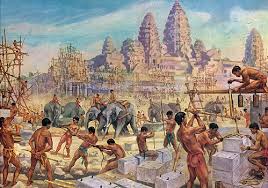
The Khmers used sandstones to construct the Angkor Wat. The blocks were collected from Mount Kulen. The Khmers used a combination of elephants, coir ropes, pulleys and bamboo to put the blocks in place.
The sanctuary complex at Angkor Wat, only outside of Siem Reap, Cambodia, is world acclaimed for its multifaceted lotus-bloom towers, its cryptic grinning Buddha pictures and dazzling moving young ladies (Apsara), and its geometrically consummate channels and supplies.
The stones, as smooth as cleaned marble, were laid without mortar with tight joints that are once in a while elusive. The pieces were held together by mortise and tenon joints at times, while in others they utilized dovetails and gravity.
Angkor Wat, situated at 13°24′45″N 103°52′0″E/13.41250°N 103.86667°E, is an exceptional mix of the sanctuary mountain, the standard configuration for the realm's state sanctuaries and the later arrangement of concentric exhibitions.
Angkor Wat lies 5.5 kilometers (3.4 mi) north of the present day town of Siem Reap, and a short separation south and marginally east of the past capital, which was focused at Baphuon. It is in a zone of Cambodia where there is an essential gathering of old structures. It is the southernmost of Angkor's fundamental locales.
Angkor Wat lies 5.5 kilometers (3.4 mi) north of the advanced town of Siem Reap, and a short separation south and marginally east of the past capital, which was focused at Baphuon. It is in a zone of Cambodia where there is an imperative gathering of antiquated structures. It is the southernmost of Angkor's primary destinations.
is the modern name of the temple at Angkor, Siem Reap Province, Cambodia, built in the Bayon style largely in the late 12th and early 13th centuries and originally called Rajavihara (in Khmer: រាជវិហារ).
Angkor Wat (Khmer: អង្គរវត្ត or "Capital Temple") is a sanctuary complex in Cambodia and the biggest religious landmark on the planet. It was initially established as a Hindu capital for the Khmer Empire, bit by bit changing into a Buddhist sanctuary toward the end of the twelfth century.
Angkor is a standout amongst the most vital archeological locales in South-East Asia. Extending over approximately 400 km2, including forested range, Angkor Archeological Park contains the grand stays of the distinctive capitals of the Khmer Empire, from the ninth to the fifteenth century.